


Industrial folding gates · made to order
Folding
security gate for
industry and critical
infrastructure
Why folding
Same passage. Half the footprint.
Each leaf is split in two. When opening, the sections fold in sync and stack against the post — so the gate needs no depth in front of the entrance and no side runway along the fence. On a tight site it's often the only solution that fits at all. The numbers below are for a six-metre passage.
Swing gate
3 metresclearance in front of gate
Morez folding gate
1.5 metresclearance in front of gate
Sliding gate
6.5 metresside runway
-
Space
50 %
Half the footprint depth
At a six-metre passage, 1.5 metres instead of the 3 metres a swing gate needs. The area in front of the entrance stays usable for a vehicle to wait, not a dead half-circle.
-
Passage
Fullwidth
No side runway
A sliding gate needs 6.5 metres of clearance along the fence for a six-metre passage. Folding needs none — it opens into itself.
-
Industry
Highload
Built for heavy use
Built for intensive operation — power plants, factories, meat-processing plants, logistics halls. Trucks, shifts, suppliers. Not one open in the morning and one in the evening.
-
System
Entrypoint
More than a gate
License-plate reader, face recognition, cards, time tracking, electronic gatehouse, breathalyzers, turnstiles, parcel boxes. The gate is the end element of an access control system we supply in full.
-
Manufacturing
Made toorder
Made in Slovakia, up to 8 metres
The steel structure is made here in Slovakia, sized to your specific entrance, for passages up to 8 metres wide. Powder-coated in the RAL shade of your choice. No adapting the building to a catalogue.
-
Service
Ownteam
Installation and maintenance in-house
Surveying, manufacturing, installation, inspections and spare parts all go through one supplier. When something's wrong, there's no one else to blame.
Components
What the gate is made of.
We manufacture the structure in Slovakia; the drive and hardware come from a European manufacturer of industrial gate automation. The mechanics keep the gate running for years, the electronics decide who gets through. We supply and service both parts ourselves — we're not an installer bolting a third-party reader onto someone else's gate.
-
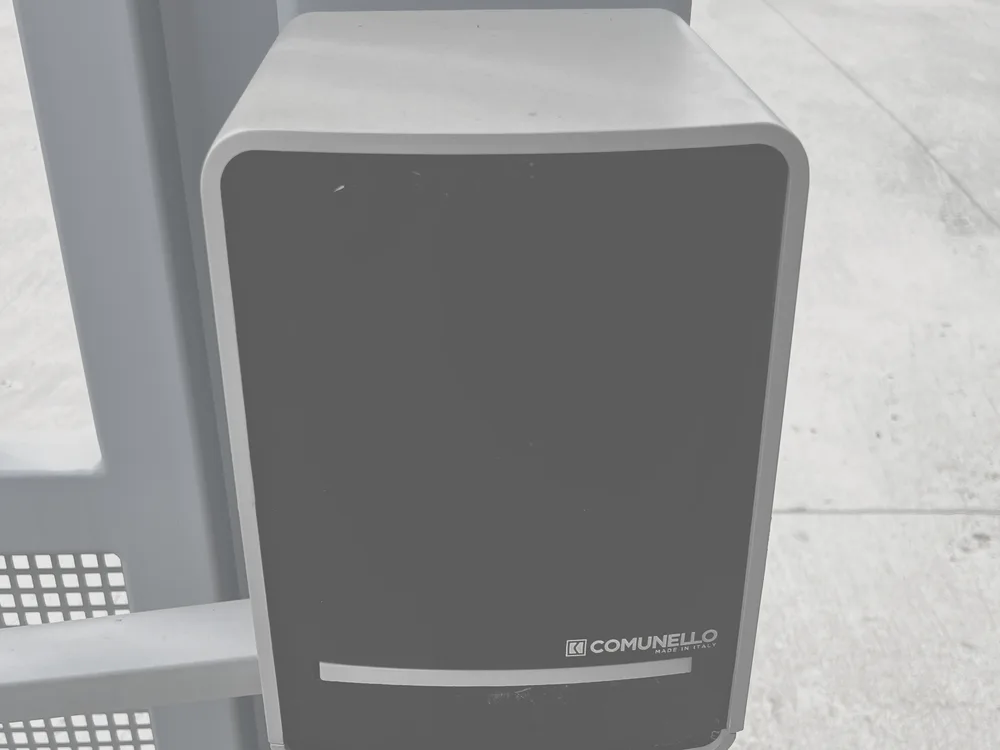
Drive and gearbox
An electromechanical drive with an arm and a self-locking gearbox on every leaf, cast in aluminium alloy. Start and stop are ramp-controlled, so the leaf doesn't slam into its stop — that's the difference between a gate that lasts for years and one that wrecks its stops after a season. On a power cut, it unlocks with a key and the gate opens by hand.
-
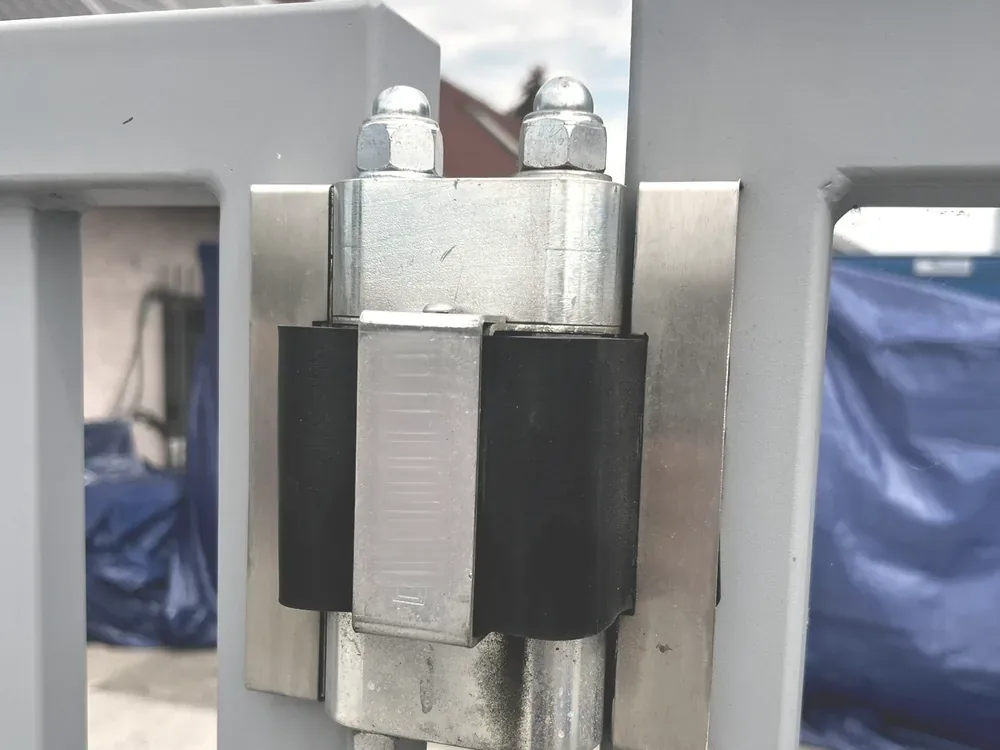
Hinges and joint mounting
A folding gate has two axes per leaf: the hinge on the post and the centre joint where the leaf folds. The centre joint carries the full weight of the outer section on every cycle — which is why it has a geared pin mechanism, bearing mounting and a rubber stop against pinching. An adjustable bracket lets you fine-tune the gate after the building settles, without removing anything.
-
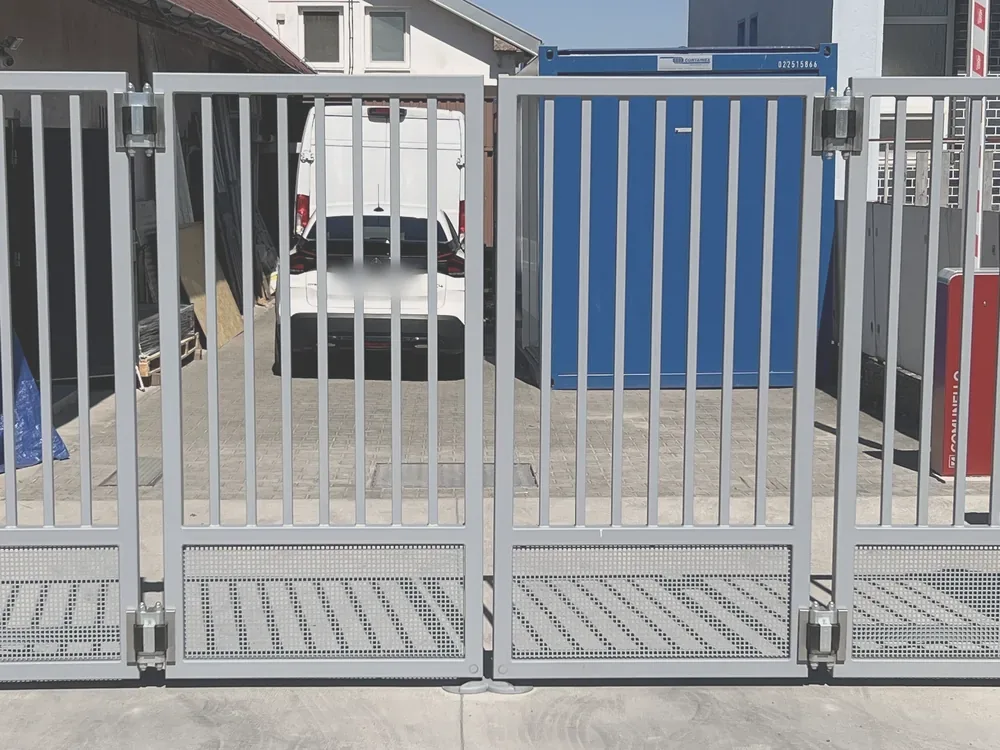
Leaf, infill and finish
A steel structure of closed profiles, welded and powder-coated here in Slovakia — not a resold semi-finished part. The infill depends on what the gate needs to do: vertical bars for visibility and airflow, perforated sheet for partial screening, a solid panel for full privacy. Pick the shade from the RAL swatch book.
-
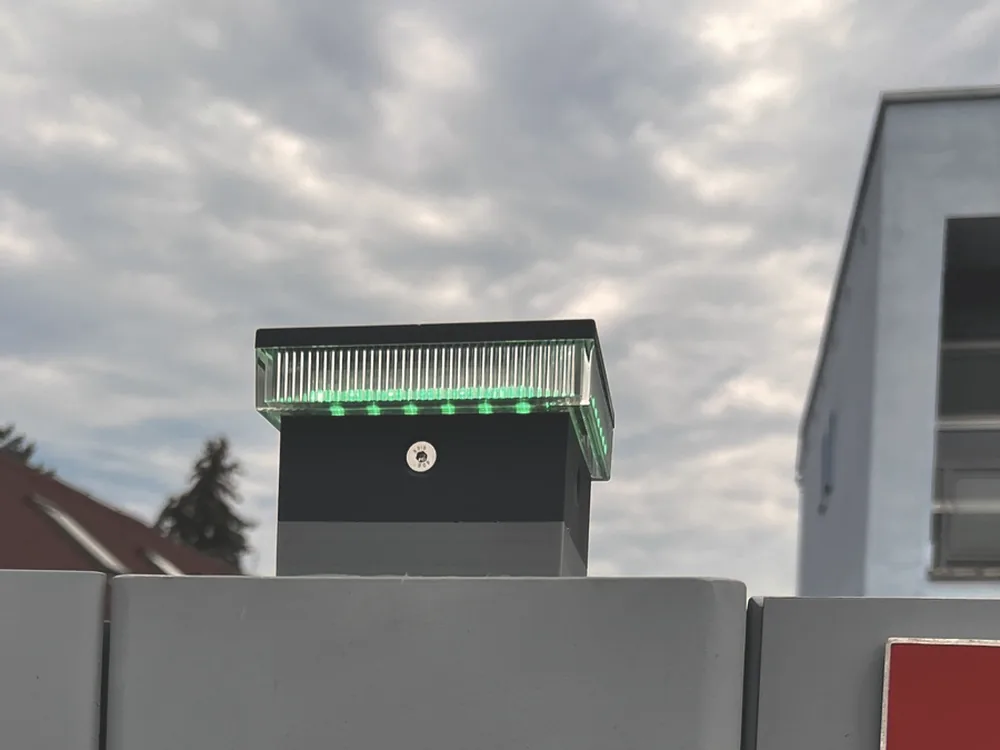
Control, signalling and safety
A control unit in the cabinet by the gate synchronises both leaves, holds the operating modes and logs events. Safety is handled by a photocell in the passage, a contact edge on the leaf and a warning beacon — the gate falls under EN 13241 and EN 12453, so these aren't optional extras but a condition of commissioning. Gate status is shown by LED signalling — green for clear to pass, red for no entry. The driver sees it from a distance that still leaves time to stop.
-
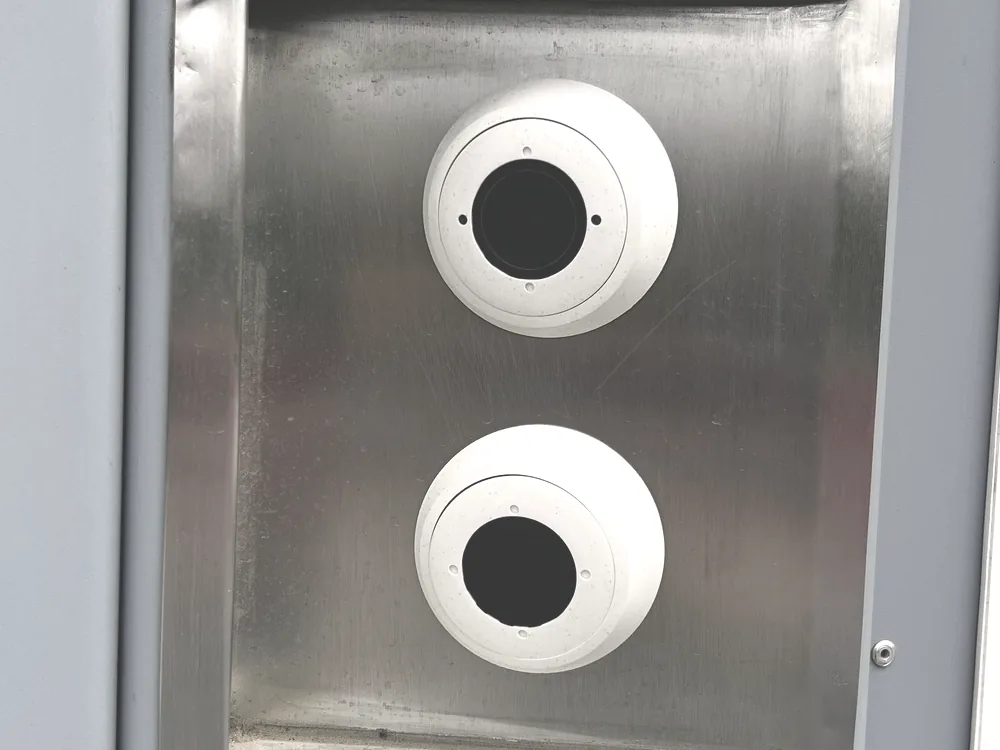
License-plate reader — vehicle recognition
A camera at the entrance reads the vehicle's plate and the gate opens on its own if the vehicle is on the list. The driver doesn't roll down a window, hunt for a card or call the gatehouse. For freight traffic, where dozens of vehicles pass through a day, it's the only way to keep a queue from forming at the gate.
-
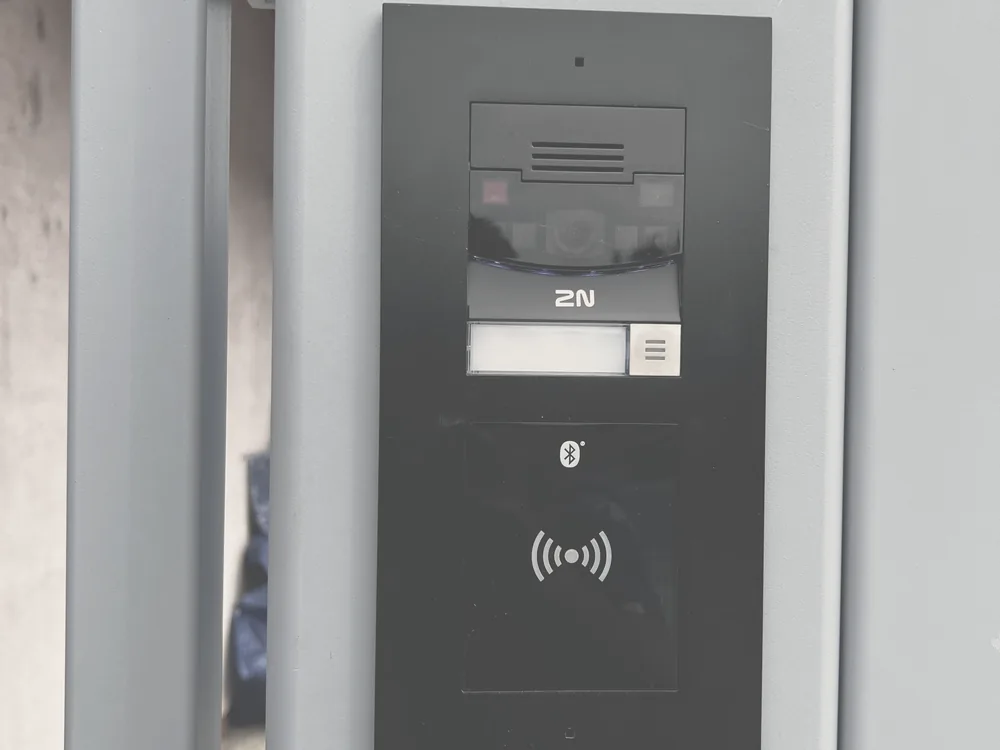
Face recognition
A terminal at the pedestrian entrance, or at the gate for drivers. Card-free identification means it can't be lent, lost or forgotten at home — and it's always clear exactly who entered and when. Biometric processing falls under GDPR, so we also supply the impact assessment documentation and retention-period setup.
-
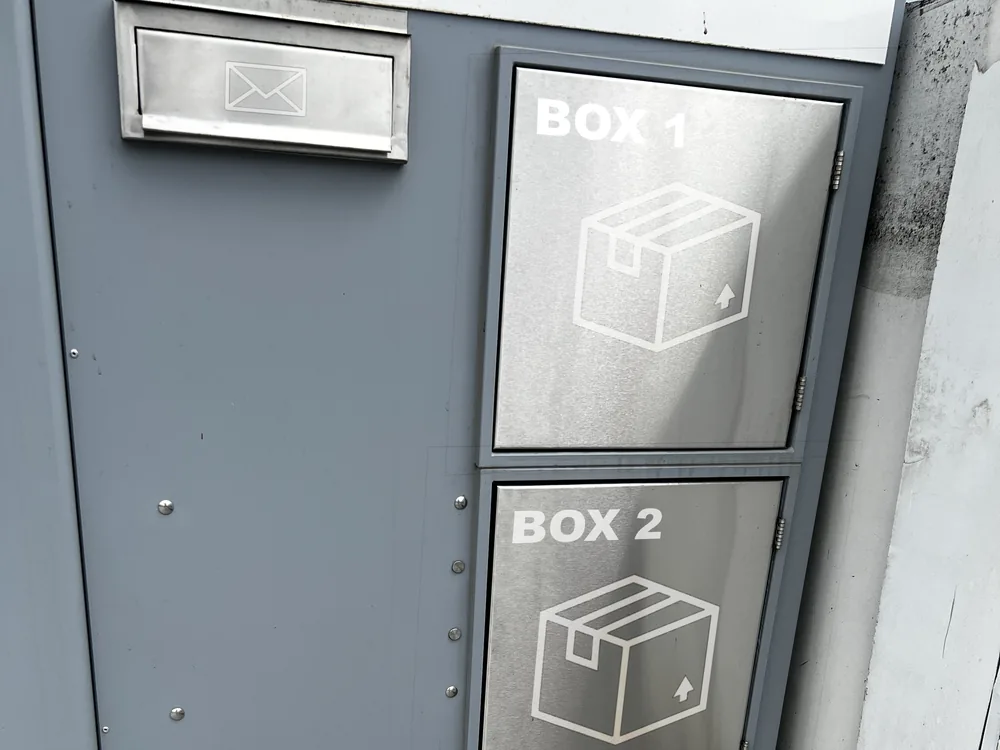
Mail and delivery boxes
The courier doesn't need access to the site — they leave the parcel in a box by the gate and the recipient gets a code. The entrance can stay closed during the day, when it's often left permanently open at most sites just for deliveries. The boxes can stand alone or be built into the gate post together with the reader.
In action
Ten seconds from command to passage.
Real footage from an active site. On both sides, the outer section of the leaf folds inward — the gate opens to its full width without anything crossing the area in front of the entrance. The post shows both the reader and the parcel boxes.
Scope of supply
From design to service.
The entire entry point from one supplier — gate, drive, access control, electronic gatehouse, breathalyzers, turnstiles and time tracking. You're not coordinating a builder, an electrician and a gate supplier — and if something doesn't fit, there's no one to blame but us.
-
01
Design and planning
We go through what the entrance needs to handle — traffic intensity, vehicle types, ties to existing access control and time-tracking systems. The output is a technical design with an installation drawing and a parts list, not a ballpark price over the phone.
-
02
On-site survey
We come to the entrance and measure the actual conditions — clear width, slope, ground, distance to the power connection. Most installation problems come from a dimension copied off a plan that reality didn't confirm.
-
03
Custom manufacturing
The steel structure is manufactured in Slovakia to the measured dimensions, not adapted from a semi-finished part. Powder-coated in the specified RAL shade, matched to the site's existing fencing if needed.
-
04
Installation
Installing the structure, drives, cabling, control unit, safety devices and connecting all the entrance electronics — readers, gatehouse, turnstiles, breathalyzers. We plan the installation so the entrance stays passable — an operating site can't have its entry closed for three days.
-
05
Handover and inspection
Setting forces and stops, testing to EN 12453, operator training, and handover of documentation including the declaration of conformity. From that point the gate is fit for operation on paper too.
-
06
Service and spare parts
Regular inspections based on how hard the gate is used, and callouts when something breaks. A gate that won't open stops shipments — that's why we keep parts in stock and the same team that installed the gate handles service.
Everything else that belongs to an entrance
The gate doesn't have to be a standalone order. We can build the whole entrance — including everything that comes after it.
- Electronic gatehouse with turnstiles
- Breathalyzers at the entrance
- Access control and time tracking
- Turnstiles and pedestrian access control
- Systems for industry and critical infrastructure
- Perimeter protection
- CCTV systems
- Intrusion alarm system (PZS, EZS)
- Fire alarm system (EPS)
- Voice fire alarm and public address system
- Data networks and structured cabling
- Electrical installation work
Gatehouses with turnstiles are also available to rent — for construction sites and temporary operations.
Specifications
Numbers you can design around.
50%
space saved
10s
opening time
8m
max. passage width
90°
opening angle
| Passage width | up to 8 m |
|---|---|
| Leaf height | per entrance height |
| Number of leaves | 4 (2 + 2), per entrance width |
| Structure | steel, made in Slovakia |
| Finish | powder-coated, RAL shade of your choice |
| Clearance in front of gate | ¼ of passage width — 1.5 m at 6 m |
| Power supply | 230 V or 400 V, per drive |
| Drive IP rating | per selected drive |
| Temperature range | per selected drive |
| Opening time | ≈ 10 s |
| Duty cycle | built for industrial load |
| Standards | EN 13241, EN 12453 |
Inquiry
Send us your entrance dimensions,
we'll get back with a solution.
Just the opening width and location. We'll get back to you with a proposed setup and a date for a free on-site survey — no obligation, no sales pitch.
- Reply within two business days
- Free on-site survey
- Made to order, up to 8 metres